Introduction:
At a company where your story spans blockbuster vaccines, patent cliffs, cancer treatments, and cutting-edge science, how do you run a successful IR program?
We learned the answer starts with a story. And a very deliberate one at that.
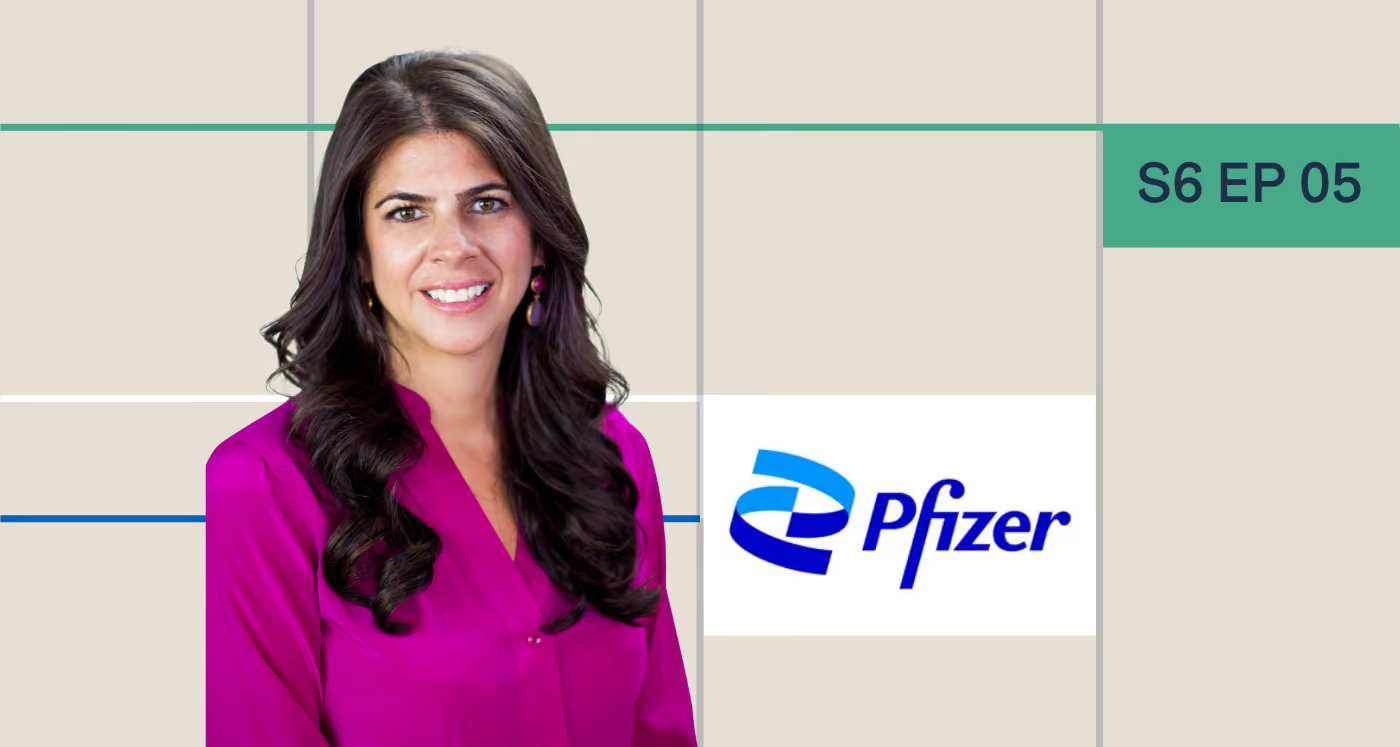
Francesca DeMartino, Chief Investor Relations Officer at Pfizer, sits at the intersection of science and finance, consumer brands and complex clinical data, generalist investors and PhD-level specialists. Navigating all of it, often in the same day, requires a rare combination of financial fluency, scientific literacy, and communications.
In this episode, Francesca pulls back the curtain on how IR really works inside a company as large and complex as Pfizer. She offers a masterclass in what well structured, strategic IR looks like at the highest level.
Let's get into it.
Mark Fasken: So Francesca, this whole season has been about sector-specific themes, and so I want to start off with a question that is sector-specific. What makes pharma IR different from other industries? What would IROs in other industries be surprised to learn about running an investor relations team within the pharma industry?
Pharma IR Compexity
Francesca DeMartino: Yeah, I think it's a great question, and I'm happy to sort of demystify it. You know, I think one thing that is true, that doesn't differentiate it, is that it's a very dynamic sector. There's always something going on in pharma. But, you know, having spent the majority of my career more at medical device companies, there's been some insights that I've, realized from working in pharmaceuticals that I think is, is sort of worth knowing.
Francesca DeMartino: First of all, you think about a place like Pfizer and you're dealing with science, but you're also dealing with very visible brands. So, you know, during the pandemic, we developed the Comirnaty vaccination. It'd be hard to find a person walking on this planet that isn't aware of that Pfizer household brand.
Francesca DeMartino: Sometimes we have to remind ourselves that a pharmaceutical company, even though there's drugs that you just go to the pharmacy and ask for, there is a consumer element to what we do, and that there are very visible, recognizable brands that we work with and that we're developing.
Francesca DeMartino: The other thing that's pretty particular that I've had to have a good learning curve around is this whole concept of what we call LOEs, or loss of exclusivity. Pharmaceuticals have a shelf life. They have patent expirations. And the Street knows when they're coming.
Francesca DeMartino: They know how to measure them, meaning quantify them. And so there's something that you inherit when you come to pharma called a patent cliff, and it is a very normal cycle within pharmaceuticals where a product or a group of products will come to expiry, and you have to manage around that. You have to know this brand's coming off patent in this year, and it's something that's very actively discussed with the Street and, like I mentioned, typically, you know, quantified.
Francesca DeMartino: Those are a couple of things, but it bears reminding people that the financials of this company are still important. Even though you're dealing with science, you're dealing with brands, you know, sometimes consumer-facing brands, the financials of the company are, are still important.
Francesca DeMartino: So, it's a really dynamic sector in that you're calling upon all of these things, science, loss of exclusivity, having to be somewhat facile on talking about patent expirations, and even trials when the patents are challenged by generics. I really love it, and, you know, that's perhaps something that you wouldn't think of when you think of a company like Pfizer or any of the big pharma companies.
Mark Fasken: And just sort of pulling on that thread of complexity, I mean, it is a very complex space, right? Pfizer itself is a very large company with a very large pipeline. It spans many different areas like oncology, vaccines. I mean, there's many different drugs. And so there's all these different outcomes, clinical trials.
Mark Fasken: How do you tailor your communications when presenting all these different complexities to a mix of specialist investors and generalist investors?
Francesca DeMartino: Yeah. It's a great question because obviously in the world of IR, you've got to know your audience.
Francesca DeMartino: And to your point, there are days where we speak to generalists. There's days when we speak to specialists. There's days where you have a room full of investors that cut across both. And, you know, one of my communications principles is you've got to know your audience. So, step number one is just knowing who's gonna be in the room, and then step number two is making sure that you can tailor your messaging to that audience.
Francesca DeMartino: And I know it sounds obvious, but it's really important because you can set up a meeting, and if you were to walk in blind and go deep on science and they're generalists, you've lost an opportunity. So, to your point that with the complexity of pharma and how deep the science can go, you've got to be able to tell a story at a 30,000-foot view, and you've also, you know, have to go very close to the science and explain the mechanism of action.
Francesca DeMartino: You know, the MOAs, you've got to be able to talk about very specific things. And you mentioned oncology, you mentioned vaccines. I have found oncology to be incredibly complex, and I'm still on a very steep learning curve, and I think I will be for the rest of my career, trying to understand that.
Francesca DeMartino: And so, you know, as an example, when you're talking about vaccines, um, you know, the treatment paradigm might be a little bit easier than if you're talking about oncology. And when you're dealing with cancer treatments, you're dealing with things called first line, second line, third line. So you know, what, what a patient journey looks like if they fail the first treatment and go to second, and these are things that you've got to be able to understand and explain, and the language that you use, the terms that you use, you have to be able to tell it in simplistic language so you don't lose that generalist and can really paint a picture of the science and the opportunity.
Francesca DeMartino: But you also have to be able to go deep. And you've got PhDs, you've got MDs now sitting on the investment side, and they will be interested in going down to that molecular level. And it's what makes pharma so dynamic and, and so interesting. But y- you've got to know your audience, and you've got to tailor that communication, again, at a 30,000-foot view and be able to go deep on the science if needed as well.
Mark Fasken: And so how, how does that actually work in practice?
Mark Fasken: I've asked some other IROs this because I've heard other IROs say things like, you know, I get my CEO in a room and my CEO's very knowledgeable in, in this particular area, and, you know, they talk and they talk and they talk and, and maybe to the point where they confuse the investor because they're either over their head or they're going to unnecessary amounts of detail.
Mark Fasken: And so when you think about going to those meetings, let's say, you know, you're going to meet with a generalist or a specialist. Are you going to the depth of saying, "Okay, we know who this person is, and we have sort of a set script or agenda," and maybe even a different deck that you're going to go through?
Mark Fasken: Are you going to that level of detail in terms of differentiating how that conversation is gonna work?
Francesca DeMartino: Yeah, I'm really proud of the setup that we have here, and I can walk you through what we have. So we're very lucky that our CEO, Albert Bourla, is a doctor.
Francesca DeMartino: He's a trained veterinarian, and so he's already able to speak to the science, and then he's obviously a businessman. So, you know, from the get-go, Albert has an ability to sit in front of a room and be able to go deep on the science if he needs to, but he's also a visionary. He's a strategist, and he's able to go high level.
Francesca DeMartino: And so starting with that tone at the top, we're in a very lucky position. And I think that from there, the picture that I would paint for you is that because he has that mindset going in where he can do the science or he can do the business strategy or do both and the financials, he's very good at then assembling the bench around him, which I'll speak to, and then starting off the question and answering himself at that high level or passing it on to somebody else in the room that's an expert.
Francesca DeMartino: So what, we've done is we've been, at Pfizer is we've been very methodical about assembling a list of spokespeople, and we're very thoughtful from the IR team. We're very thoughtful about who are we gonna meet with today, going back to, you know, what we were discussing before, knowing your audience and then taking copious notes on those meetings
Francesca DeMartino: by the way, that we've had with those investors. so one of the things we pride ourselves in, as an IR team of doing is saying to our executives, "We're gonna meet with X, Y, and Z. These are generalists or these are specialists. In the past, they've asked about X, Y, and Z, and we think we should have the following people in the room. And that's sort of the way that we approach it.
Francesca DeMartino: It's a great question on your part. We don't have different decks per se, but we are able, because of the people we have in the room, to tailor the messaging and the depth we go into based on who's sitting in the room. And again, if you think of Albert as that master of ceremonies where he starts and perhaps, you know, Wellington's, one of our top holders. They are incredible investors. They go deep on the science. They can flex high, they can flex low. But we know to bring our head of R&D, Chris Boshoff, to that meeting so that Albert can do a strategic message, hand it off to Chris Boshoff if he needs to, where he can go deep on the science.
Francesca DeMartino: So it's really just a varied step process where, you know, just to wrap up what I'm saying, know your audience, assemble your speakers, thoughtfully And carefully depending on who that audience is, and then have a combination of speakers really be the ones to interface with the street based on what you know they're gonna look for.
Mark Fasken: That's great.
Mark Fasken: And I don't want to belabor this subject, but in thinking about IR teams who are maybe slightly newer or maybe slightly, you know, smaller company, as Pfizer, you've met with probably many of the large investors in the world, so you have that knowledge and have that depth.
Mark Fasken: If you were though going into a situation where it's a new investor, you've never met with them before, are you then sort of doing a pre-screen? Where it's like, let's give you a little bit of information on the company, understand your level of knowledge so that when we have that larger team meeting, we know who we need?
Francesca DeMartino: My advice is don't be afraid to ask your attendees before the meeting what they're looking for. We don't have to go in blind as IR teams.
Francesca DeMartino: I think it's incumbent on us to educate ourselves and our executives as to the room they're walking in on. I mean, very rarely I don't... I, I'd have to sit here and think we're like, you're just sprung with a meeting where, you know, maybe they change the audience, but let's say that's not the case, and this is a non-deal roadshow, it's a conference, whatever, you know, a call.
Francesca DeMartino: Reach out and say, we know you're new to the stock, or we're new to you. What are you looking to get out of the meeting? We want to assemble the best group of executives to meet your needs. Help us understand what you want to focus on. Are you new to the story, or have you been following, you know, the last couple of earnings announcements? Like, where have you left off on the story so that we can put our best foot forward?"
Francesca DeMartino: Don't be afraid to be direct and ask the question, under the umbrella of we want this to be productive for you and for us. Help us understand what you're looking to get.
Francesca DeMartino: Just ask the question.
Mark Fasken: Yeah. Yeah, absolutely, and I think I'm sure many investors really appreciate that, that you're going into it- Absolutely... with the view of how do we make this effective for you.
Mark Fasken: We talked a little bit about the team structure, and maybe we can go into a little bit more detail in that because in our pre-call, we talked about the importance of building your bench. I've heard that term used by you, and by many other IROs, sort of having a deep bench and sort of drawing on that bench.
Building the Bench
Mark Fasken: Do you think that sort of the complexities of Pfizer have impacted how you have built out the team? It'd be helpful if you could sort of run us through how the team is structured today.
Francesca DeMartino: Absolutely. You're going to hear me say this a lot. I'm very lucky here with both the executives that I work for, but also the team and the talent that I have.
Francesca DeMartino: There's always a dilemma, there's always a debate about what is the proper size of an IR team, and we're always going to argue for more, and, you know, there's data that suggests certain numbers and ranges. You know, I'm very lucky that I think I have a team that's fit for purpose, given the complexity and given this LOE period that we are in the period of here at Pfizer.
Francesca DeMartino: I've been very methodical in assembling a team that I'm, I'm very proud of, and it is a combination of skill sets. If you have the ability to assemble more than a team of you plus one, and even then you could argue you could apply this theory, of having folks, you know, different strokes for different folks, as they say.
Francesca DeMartino: So, meaning I think having your traditional finance-backed experts on your team is always a good thing because I don't think there's an industry where you're not speaking financials. Even if you're pre-revenue, you report earnings, you have to have projections. You need some financial grounding in order to tell a story. So, you know, folks with accounting background, investment banking background, corporate finance background, you know, if you have the luxury of, of having folks on your team that come from finance, that's great. And I've seen many iterations of this in companies where you have finance rotationals kind of coming through IR as a development opportunity, and oftentimes they like it and they wanna stay. That's sort of the finance pillar.
Francesca DeMartino: In terms of skill set, I think it's also really important, particularly when you're in healthcare and in pharma, as we've been talking about, to have scientific expertise. And the ideal situation you wanna be in is to get on a call, let's say it's an IR team only call, you don't have your executives and the IR team is handling the call or the meeting, to have a finance expert to help you with the finance, the earnings, and then your science expert to go deep, you know, again, flex up, flex down.
Francesca DeMartino: I've been very lucky to assemble a team like that. And I think the last piece I'll say, and then I'll give you a sense of the structure, Is having folks on the team who have investor relations experience is always a plus. You don't have to. You can develop it. I have a lot of members of my team where this is their first, you know, entry into IR, and, uh, but they had skill sets to draw upon that, you know, made them fit for purpose on the team.
Francesca DeMartino: But it's always nice to have somebody that can speak IR, that knows what targeting means, what whisper number means. You know, these are... This is IR terminology. But the way I've structured my team is, you know, I've got one very talented woman who does our corporate access, so she, Donna, is in charge of all things investor meetings, conferences. Knowing where we need to go and what investors we need to see. So it's the counterpart at banks having corporate access, we have that on the team.
Francesca DeMartino: And then the rest of the team is really divided between, you know, finance pillar. They look after earnings. They work on guidance. They work on consensus. They do a lot of the analytics.
Francesca DeMartino: And then the R&D team works on R&D communications, anything that is pipeline, clinical development, clinical trial data readouts, and then we've got a commercial pillar of think about it as commercialized products. So those are a whole other set. There you're talking market penetration, market share, competitive landscape.
Francesca DeMartino: So like I said, I know I'm lucky. I've got the luxury of having a team where I can check a lot of boxes, but the general approach is finance and sort of non-finance to help you tell the story and then talk about earnings.
Mark Fasken: Absolutely. And I think again, to your point, it is, a luxury, and I think you're lucky 'cause as you know, I mean, many IR teams are, are relatively small.
Mark Fasken: I think what is great about the structure you have, it's that, it's the specialization. And I think a lot of people who are listening to this who are going like, "Well, I don't have an IR team of four," you may not, but there are people that specialize in those areas within your company most likely, right?
Francesca DeMartino: Absolutely...
Mark Fasken: Like, you think if you're in mining, yeah, as an IRO, you're probably a one-person IR team, but you have geologists within the company. So I think it's like it doesn't need to all be formally within the organization. It's sort of looking and saying, "Well, how do I find those people, partner with them, and bring them into the room whenever I need them?"
Mark Fasken: Right?
Francesca DeMartino: I think it's a great point because, you know, I've been an IR team of one, of just me, early on in my career. I've been on an IR team of two, and I've been on an IR team of, call it 6 to 10, variations of that.
Francesca DeMartino: And when I was an IR team of one, you know, it's, to your point, it's important to know enough to get on a call with an investor and be able to speak the story.
Francesca DeMartino: And, and if you can't, and if there's areas that are new, then you draw upon your colleagues to help you with the messaging, and that you at least have a nice set of messaging in front of you that you can study and that you can learn and that you can repeat. The other thing I was gonna say to you is I got great advice a long time ago from an old manager who said, you know, let's say you're a team of two, so it's you, and you're looking to add somebody.
Francesca DeMartino: It seems like such simple advice, but it's so true that if you're in the market for hiring somebody, don't hire a clone of you. Hire somebody who will complement you. And it just stuck with me.
Francesca DeMartino: I really look at it as, you know, sum of parts is greater than, than the whole, right? If I'm a finance expert, which I tend to be stronger on the finance side because of my background, and I've, I've been in healthcare my whole career. But I did not, didn't pay enough attention in biology as I should have or in chemistry or, you know, and now I'm learning it.
Francesca DeMartino: So, if I was a team of two hiring someone else, I'd wanna go hire, not a finance expert, but more of that science to complement me. You know, look for those people in the organization or hire a plus one that will complement you in that regard.
Mark Fasken: Awesome. Okay, well, moving on from team structure, we talked a little bit about storytelling and sort of messaging and communications. You come from a communications background. You spent some years in corporate comms, and you have, sort of three pillars that you talked about when it comes to investor relations and sort of how you go about operating.
Three IR Pillars
Mark Fasken: The pillars are storytelling, consensus management, and targeting. And you identified those as the three most important things that you focus on within your team.
Mark Fasken: And so I thought it'd be helpful to sort of break those three down and get some thoughts from you on each one. And so we're gonna start with storytelling. I know this is something that you're really passionate about.
Mark Fasken: How do you ensure that your storytelling is thoughtful? I mean, we've talked a little bit about how you adapt your story to different audiences. But you mentioned Something that I thought was really interesting, that you stopped using traditional Q&A documents, like, 10 years ago, I think. Um- Correct... And so I guess I'm just curious to get some thoughts on storytelling, the Q&A documents, and sort of how you approach storytelling today.
Francesca DeMartino: Yeah. One of the foundations that I have, to your point, is in corporate communications. I did start in investment banking. I then went on to IR. But I did long tenures at large companies, you know, namely J&J and Medtronic, doing corporate communications work, where I really, truly, learned the importance of storytelling.
Francesca DeMartino: And it was in those assignments, that I really understood the difference between being a proactive communicator versus a reactive communicator, and it's what, you know, informed this sort of move away from Q&A, to message map. But to take a step back, you know, one of the big pillars of IR, as you mentioned, that I believe in is the story.
Francesca DeMartino: What are you telling investors? There should be a story there. There should be a vision. You really shouldn't approach your investor communications as Q&A, that you're not just there to answer your questions. You are there to tell a story and to paint a picture of where the company is, at times where it's been and where it's going, or just simply where it's going from this point in time.
Francesca DeMartino: And if you don't have your story down, please start there, you know? Name it what you want, your elevator pitch, you know, your introduction, your grounding statement, your whatever. But that storytelling is very important, and I think by the very nature of just having a story to tell, you're already moving from being reactive to proactive.
Francesca DeMartino: And being able to walk into a room and say, "Hi, I'm Francesca. I'm the head of IR at Pfizer. Here's where we are with the story."
Francesca DeMartino: But to tackle the Q&A and the message map specifically, so if you really think about Q&A documents, they literally are choppy. They're question, answer, question, answer, question, answer.
Francesca DeMartino: And I didn't love that. I didn't love the theory that investor relations teams with executives often got in a room and would list... And no offense to people that do this, by the way. It's just, uh, I, I like to approach it differently.
Mark Fasken: I think, like, everybody does it. That's the, that's the funny thing.
Francesca DeMartino: Yeah. So, so maybe I'll inspire people to do it, to think about it differently.
Francesca DeMartino: Yeah. But it's a very common exercise to sit in a room and say, "What are all the questions we're gonna get asked on X topic? Give me the hard questions." Well, you're training your executives to be in a reactive mode by nature of doing that because you're basically saying, you know, "The question that you're gonna get asked, here's the answer," and you're training them to just, like, answer.
Francesca DeMartino: Whereas what we did is we moved to message map. We did away with the... We still brainstorm questions, don't get me wrong, but the document that we work on inter-quarter and spruce up right before earnings and use during earnings prep and then inter-quarter again, is a message map where you list topics. So your brain power goes to what are the topics that we're going to get asked. you know?
Francesca DeMartino: Vaccines in this current administration, our loss of exclusivity, our pediatric vaccine and, and pneumococcal you name it, we have a document that is organized by topics or by brands. And the, the reason we do that is because the approach and the theory is that it doesn't matter what question you get asked, if it is on this topic, you are trained to give an answer, but per topic, and it puts you in a much more proactive position that your messaging is your messaging, and it doesn't matter how the question gets asked, you are prepared that if they ask about this topic, this is your message.
Francesca DeMartino: And it forces you to really think about your talk points, your proof points, your data points. Versus spending all of this brain power on what the actual question is. Let's go deep on the actual answer and do it by topic.
Mark Fasken: I don't want to put you on the spot here, but can you maybe put that into the context of an example? I think some people might hear this and say, well, aren't analysts or investors gonna get annoyed by that?
Mark Fasken: They're gonna ask a question, and then I'm gonna give them some answer that doesn't really answer their question, but just serves my message.
Mark Fasken: How do you do that in a way that, you know, you're still answering the question, it's not like you're ignoring it. You're answering the question, but you're controlling the narrative.
Francesca DeMartino: So for example, let's say you- you're on an earnings call and somebody asks, like, "Hey Francesca, what's your market share on this?"
Francesca DeMartino: Which is a very relevant question, "What's your market share on, on this?" So in a typical Q&A format, you would say, "Oh, it's 85%," right? And you're done, and you move on. What we like to train our executives to do is say, "Let me talk to you about X brand. We're very pleased with the performance in the quarter. We showed growth of this percent. We're finding that we're gaining competitive edge because more doctors are prescribing."
Francesca DeMartino: So you're giving a more holistic answer, and we're still getting in... You're still answering the question, it's just a much more holistic approach where you're saying, "We want the market to know that we had a strong quarter, that we saw growth, that our strategy to penetrate market share is working."
Francesca DeMartino: And then you can give, if you give it, you can give the market share number. Right. But you're not just training your execs, like, "Hey, when you get the market share question, the answer is 85."
Mark Fasken: Yeah...
Francesca DeMartino: It's like, hold on. This product performed very well this quarter. Tell them why." And so, like, does that, uh, does that kind of explain it?
Francesca DeMartino: Like- Absolutely, yeah... it's a more holistic approach.
Mark Fasken: So it's not to say, like, you don't answer the question, it's you provide additional context around the answer that relates back to the primary themes and message that you want to get across in that, say, earnings call or in that meeting.
Francesca DeMartino: Correct. Correct. Yeah. So for example, like to really put a bow on this, so we don't have in our document a question that says, "What is the market share on X drug?" What we have is called an elevator pitch, so it- once we start going into our brands, right, which is a topic, you know, X brand, we have an elevator pitch that is a paragraph, a set of sentences that is how that brand performed in the quarter.
Francesca DeMartino: And so you will hear our commercial leaders giving that on the earnings call. Like start with the elevator pitch. And to your point, no, we're not saying we're not gonna get... You know, market share is maybe, I, I picked a provocative one, but it just felt like a good one, 'cause we don't always give it. But let's say we do give it, 'cause on some we do.
Francesca DeMartino: You're not just giving that. You're giving context around why that number is what it is, and you're wrapping in additional information on the product in the quarter.
Mark Fasken: Absolutely. So it's not to avoid the question, it's to direct the answer more to the place that you want to end up, rather than just being- That's right
Mark Fasken: like point operated and just like- That's right... question, answer, question.
Francesca DeMartino: That's right.
Mark Fasken: Absolutely.
Francesca DeMartino: It's a conversation. Okay, great. Right? It, it makes you have a conversation. That's right.
Mark Fasken: Absolutely. Okay, Let's move on to consensus management. IR a lot of time acts as the knowledge keeper, sort of having a finger on the pulse of external sentiment. regardless of what stakeholder that is, I think it's sort of the job of IR to understand what people think about the company.
Mark Fasken: How do you keep a pulse on street expectations, and how do you communicate that up, to management?
Francesca DeMartino: Yeah. It's another great question. You have to think about it in terms of the sell side and the buy side. We live in an environment where consensus is alive and well and holds us to a set of numbers every quarter. And the easier parts of that is these are published.
Francesca DeMartino: There's consensus houses, analysts publish their models. And so just to stay on that for a minute, I think it's really critical, you know, if you're a company that trades on this kind of stuff as we do, it matters what revenue and EPS number we post versus consensus.
Francesca DeMartino: It is really imperative, and I, I could talk about this for hours 'cause I'm very passionate about this, but it's really imperative that you understand your analyst models, that you know where their expectations are in terms of assumptions for X product in this year, that you know what is behind that aggregated consensus number.
Francesca DeMartino: And there's all sorts of things that we do here at Pfizer with outlier reports to know that if there's a number that is off from where we're gonna report, that we understand, um, A, that it's off, but B, that we know how to go deep and know perhaps what analyst is pulling the average up or down, and if there's a way to obviously legally and compliantly correct it and address it, in a way that's again, compliant.
Francesca DeMartino: That's one set. So to answer your question, you know, it's really important that as an IR team, we know all of those complexities behind those numbers, and that we can speak intelligently to an executive team going into earnings around, "Hey, you know, we're gonna report X cents. Um, the street's here. If there's a discrepancy, we're working on it. Here's what we think. Why the discrepancy exists is because these models haven't been adjusted for this messaging, or we have an outdated model in there."
Francesca DeMartino: Whatever the case may be, know your numbers, know your consensus, know what's behind it, and work actively.
Francesca DeMartino: Again, the goal is not, you cannot force an analyst to change their estimates, but you can remind them of what you've said in order to get, you know, things within a working range. When you go to the buy side, you know, there's no published models. You have to go out and get that intelligence.
Francesca DeMartino: And just a plug for companies that do perception studies, I've done them throughout my career. I think they're wonderful. I think if your budget allows for them, have a systematic cadence of doing perception studies. We're not always at the liberty of having the budget or the time to go do that.
Francesca DeMartino: So I would say to really form those relationships with your investors and have the handful, you know, the five to 10 that you can call that represent your current, your perspective, your bulls, your bears, your long onlys, your hedge funds that you can call and get, you know, a splattering of, "Hey, what'd you think of the quarter?" Or, "What are your expectations going into this data readout?" Whatever the event may be.
Francesca DeMartino: Obviously ask them, "Are you okay that I provide this to management in a verbatim style?" And I've done that. I've done that when the stock's been acting erratically, and we don't know.
Francesca DeMartino: There's all these tools we have, you know, to draw upon to understand stock behavior, but it's one of the biggest things we've got to demystify on a daily basis. And sometimes you just need to go ask, like, "Hey, what's going on here?" Or like, "What, what did we get wrong? What, what are we getting right?"
Francesca DeMartino: And going out and getting that intelligence, and it's based on those relationships that you formed and that ability of you to call the investor and then aggregate that all in a simple email. And now we have AI tools that are like, "Here's all the stuff we heard. Summarize it for me." And then you send it off, and it goes a long way.
Francesca DeMartino: Oftentimes it's what we're telling management teams, but they care, it, for whatever reason, I won't try to validate or invalidate it, it carries a lot of weight when it's like, "Hey, this is what the investor feedback is on this topic." So.
Mark Fasken: I'm always surprised though when you hear IROs who say that their management team like at times writes off that type of feedback or like doesn't believe that type of feedback.
Mark Fasken: And, you hear some IROs that say then, we had to hire somebody to do a perception study for us to get some results that were the same as what I've been telling our management team for months. Sometimes the messenger is the message, right?
Mark Fasken: One other question on this. How frequently are you reporting back to management on investor feedback and investor sentiment? If you had a meeting with investors, you go to a conference, let's say, you have a bunch of meetings in a short period of time, are you pretty quickly after that doing a write-up and sending it over to management?
Mark Fasken: Or do you sort of hold off and deliver that on sort of a monthly or quarterly cadence?
Francesca DeMartino: I would say a little bit of both. If we just did a roadshow, um, you know, when we go to Europe, we're very good about asking for the feedback. And European investors, bless them, they're very good about providing and stopping and sending pretty lengthy feedback.
Francesca DeMartino: So, that tends to generate on its own. I like to be intentional. You know, our CEO and CFO, they're busy. They get a lot of information. If we go on a roadshow and it's just sort of status quo and it's more of the same, like particularly if it's after earnings and it's similar to what they've already heard on the post earnings call, call backs, I won't bother.
Francesca DeMartino: Right. That said, we do publish a monthly report, and we include a slide in the monthly report that has topics of interest, and we refresh that every month. And it is literally what it sounds like. It is a list of, you know, anywhere from five to 10 of the top topics that we're being asked by the street, and it's bolded, and then it's got a couple of words to just sort of elaborate on what we mean.
Francesca DeMartino: So that happens very often. Every quarter, there's a town hall. It's very usual that I get up and speak with the CFO on how the quarter went and what sentiment is. So there is a really nice cadence here of constant feedback. You know, and again, it's a mix of intentionality of like if we're coming out of a roadshow and something new came up, I will provide that. Otherwise, I rely on these more planned events of a town hall, or the monthly report, where I know the CEO is going to be looking and I'm not bombarding his inbox.
Mark Fasken: Well, we can move on to our third pillar, which is targeting. What are your top tips for targeting? I mean, it's a constant topic in IR. People are always talking about how they can do it better.
Francesca DeMartino: Yeah, I... You know, there's a very standard way of doing targeting. You look at your peers, you look at, who they're owned by, and you reverse engineer if they own you and if you should go target.
Francesca DeMartino: There's a lot of merit in doing that. I think what's been very helpful and successful, I think at current company and the last two that I worked at In IR is, you know, this dual approach of, one is segment the potential investors. Don't forget the ones you currently have.
Francesca DeMartino: There's the top 10, which you should always pay attention to, or wherever you wanna cut it off. Top 10, 20, 25. And then there's sometimes these fringy ones where keep an eye on the ones that are slowly sort of bleeding out or bleeding in - you wanna create stickiness.
Francesca DeMartino: And then there's the good old targeting of folks that you know should be in the stock but aren't.
Francesca DeMartino: Whether this is earth-shattering to people or not, we do all of that work where we say who are the ones we wanna... You know, the top 10 that we've gotta pay attention to, who's drawing down and drawing up, and we wanna either get them back in or stop the bleeding or whatever it may be.
Francesca DeMartino: And then there's a list of perspectives, and they're divided by geography. We have all kinds of tiering and potential holdings and all these things that allow us to tier.
Francesca DeMartino: But the thing that I wanna add that, you know, I've learned and taught the team and worked with the team to do, which I think is often a thing that is not sort of thought through, which is- Once you tier, let's say you tier tier one, tier, which is what we do here. We have tier ones, tier twos, and tier threes. Your tier ones is really only a handful. I would not go above 30, let's call it, it's a company of Pfizer size. Those are investors that you are going to put your CEO and CFO in front of. So what I'm getting at right now is executive time against those targeting tiers.
Mark Fasken: Mm-hmm.
Francesca DeMartino: So tier ones, CEO, CFO, these investors call, we have an opportunity to see them. You go knock on, you know, the office in the corner and say, "We have this person coming in. This is a good use of your time." And again, small number.
Francesca DeMartino: The next tier, the tier twos, are the ones that you'll put maybe your SVPs and VPs to see, you know? Folks that report to the head of R&D, the CEO, the CFO, like that sort of second bench.
Francesca DeMartino: And then tier threes are IR. So those are accounts that IR dedicates, and as you move down the tiering, that pool of investors gets larger. So, my overarching message is don't just stop at the tiering. Really think about marrying those tiers to executives and who the right groups of people on your executive team are to put in front of those tiers, and it makes for a much easier presentation to the management team to say, "When you see a tier one, it's one of these X amount of people, and we vetted it, and this is a good use of your time."
Francesca DeMartino: And the same thing with twos, and then IR takes everything else.
Mark Fasken: Awesome. Well, that's our three pillars, storytelling, consensus management, and targeting. Thank you.
Mark Fasken: We're into our last question. This is maybe a little bit of a more personal one. You're Pfizer's first female IRO.
Career Advice for IROs
Mark Fasken: Not only that, but you are also the chief IRO. I don't think that there's a lot of chief IROs out there, which is really cool.
Mark Fasken: So, what advice do you have for other IROs, particularly women, but, I mean, it can be really anybody earlier in their career, whatever it is, you know, who are looking to rise up the ranks in IR?
Mark Fasken: I mean, I- I'll say from my perspective, speaking to so many IROs and doing this podcast, the term seat at the table comes up all the time. You know, people want to have influence and input. And I feel like you have done a really amazing job of gaining that level of trust, from your management team, and I'd love to just hear any advice you have.
Francesca DeMartino: Well, thank you for the question and for the acknowledgement. This is something I'm very, very proud of.
Francesca DeMartino: I think there's so much I could say on this topic. You know, one is, Act like you have the seat at the table, not like you are aspiring to get it. I always remind myself when I get up on stage and present, that myself and my IR team, we are the best people in this building to speak on this subject. Know that. Have the confidence to know that you're in this function and you're in this role because you are the expert.
Francesca DeMartino: And behave that way. Behave like you know things that other people in that room don't know, and that you are there to provide.
Francesca DeMartino: That's one thing. Two is this business of IR is so much about relationships, and I've invested a lot of time in building the relationships internally and, you know, when I came to pharma from med tech, almost three years ago, I didn't know the buy side, I didn't know the sell side.
Francesca DeMartino: I mean, you learn a whole new set of stakeholders and investors and analysts and, you know, invest the time to get to know your audience. I've said it a lot, you know, throughout our time together because that is who is going to give you the intelligence to be able to connect the dots and be smart on your stock and go feed that back to management.
Francesca DeMartino: They're looking to you to tell them what is going on with the company, with the stock, with the valuation, and you can't guess your way through this. I have good gut instinct, but I still, as we were talking about before, you've gotta bring data, you've gotta bring quotes, you've gotta bring third-party validation.
Francesca DeMartino: And in order to get things done, you need to have the internal relationships to get the work done cause you can't do it all yourself, and then go invest in those investors, those analysts, because it's all just a big spaghetti bowl that you're trying to put together and figure out. So I've just really invested a lot of time in knowing that if I want that seat at the table, I can work hard and earn it and I deserve it. And I encourage my team to have the same, to have points of views to connect dots, to have things to say and, and then just build those relationships and take them very seriously.
Mark Fasken: Great.
Mark Fasken: You know, one thing I'll just say as an observation in just in speaking to you today and in our prep call is I feel as though you've done a really great job of building sort of these frameworks of how you think about your team, how you think about communication, how you think about even allocating management time to your targeting list, right?
Mark Fasken: It's very, very thoughtful, and I feel like that is something that many people in general, like everybody, I think, can be a little bit more structured and thoughtful. But I think a lot of IROs probably feel as though they lose control of their own time, right?
Mark Fasken: Like you're beholden to the buy side or your management team, and I think that's just something I've observed from our conversations. You're just very thoughtful and very well-structured. So thank you for bringing that structure. Thank you for that... And those thoughts to the podcast.
Mark Fasken: We really appreciate your time. Thank you so much.
Francesca DeMartino: Likewise. Thank you so much for the chat. It's been a pleasure. Anytime.
Mark Fasken: I hope you enjoyed this episode of Winning IR, the investor relations podcast. Winning IR is brought to you by Irwin, the IR solution designed with engagement in mind. For more information and episodes, visit www.getirwin.com